Tag

alaska

Browsing

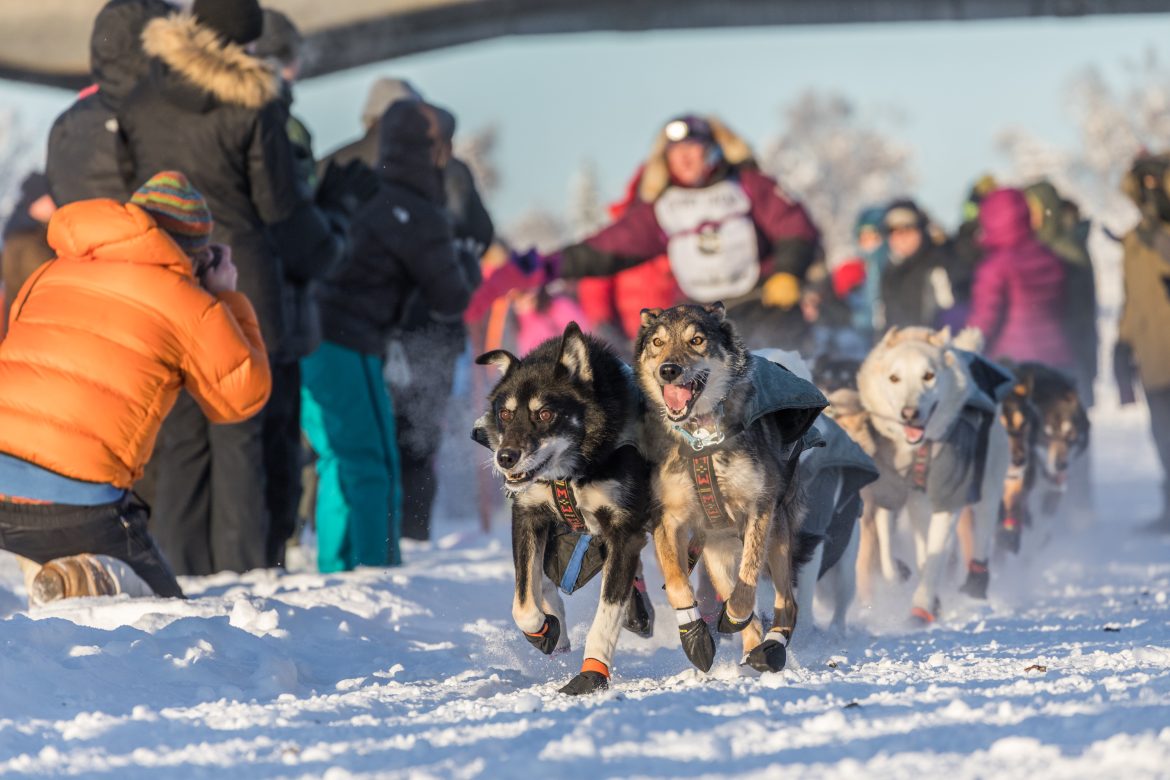
March events bring sports and culture After 10 years abroad, the Arctic Winter Games return to Alaska this March 10-16. And for the first time, they will be held in the Matanuska-Susitna Borough north of Anchorage. “This is an amazing opportunity,” says Karen Lane, general manager of the 2024 Arctic Winter Games Host Society. “Alaskans can watch athletes competing from across the circumpolar north and experience cultural activities not often seen here.” Since 1968, the games have offered young athletes from northern and arctic nations a chance to compete on a global stage. Held every two years, they feature dozens of competitions, including skiing, hockey, and demanding Indigenous sports like the two-foot-high kick, kneel jump, and knuckle hop. An expected 2,000 athletes will compete this year from Alaska, Greenland, Scandinavia, Canada, and elsewhere. February is crunch-time for the host society, which for over a year has been planning a blizzard…

Alaska Native place names in this issue Iilgayaq (Bristol Bay) Possibly refers to a place to hide. Some Yup’ik language speakers say the name describes all of Bristol Bay, while others say it only refers to the Nushagak area of the bay. See the “Sense of Place” section for more on this special place. (source: Bristol Bay Native Corporation online place names mapping tool) Utqiagvik On December 1, 2016, residents of Barrow, mentioned in the “History” section, narrowly voted to change the city’s name to Utqiagvik, an Inupiat name meaning “place to gather wild roots.” (source: Inupiat Heritage Center) Taan (Prince of Wales Island) The Tlingit word for sea lion and the setting for the “Community” article. (source: Our Grandparents Names on the Land, edited by Thomas Thornton)

Good riddance to the days of film Very few people are nostalgic for the old days of photo processing: the interminable wait to see if you got even one decent image on a roll of 36 frames of film, the abject disappointment if you failed to, and the cost of prints and slides. If you had your own darkroom or worked in one, the routine included agitating film canisters by hand, mixing smelly chemicals, wielding tongs and washing trays, and the constant fear of light leaks. Wild horses couldn’t drag me back to those times, but I did have some interesting photo lab jobs over the years. My first was in a small Wasilla-based business. During that time, I also volunteered at a horse boarding stable and had lightly frostbitten my fingertips while wearing damp gloves. I quickly learned that peeling fingertips from winter’s nip does not go well with…

More than you see, fewer than you think peered around a boulder and there they were: a half dozen Dall rams bedded down, the nearest so close I could see my reflection in an amber eye framed by a curl of horn. They turned their heads to regard me but didn’t rise; instead, they gave what seemed to be a collective shrug as I settled in and raised my camera. I spent the next hours among them in the late August sun as they napped and grazed along the edge of that rock-strewn ridge, the air so still I could hear the echoing rush of the creek 2,000 feet below. That afternoon, still vivid after decades, explains as well as any why I came to Alaska: to meet wild animals in big, wild country. Pretty much everyone Alaska-bound hopes, even expects, the same. No doubt they’re out there, millions of…

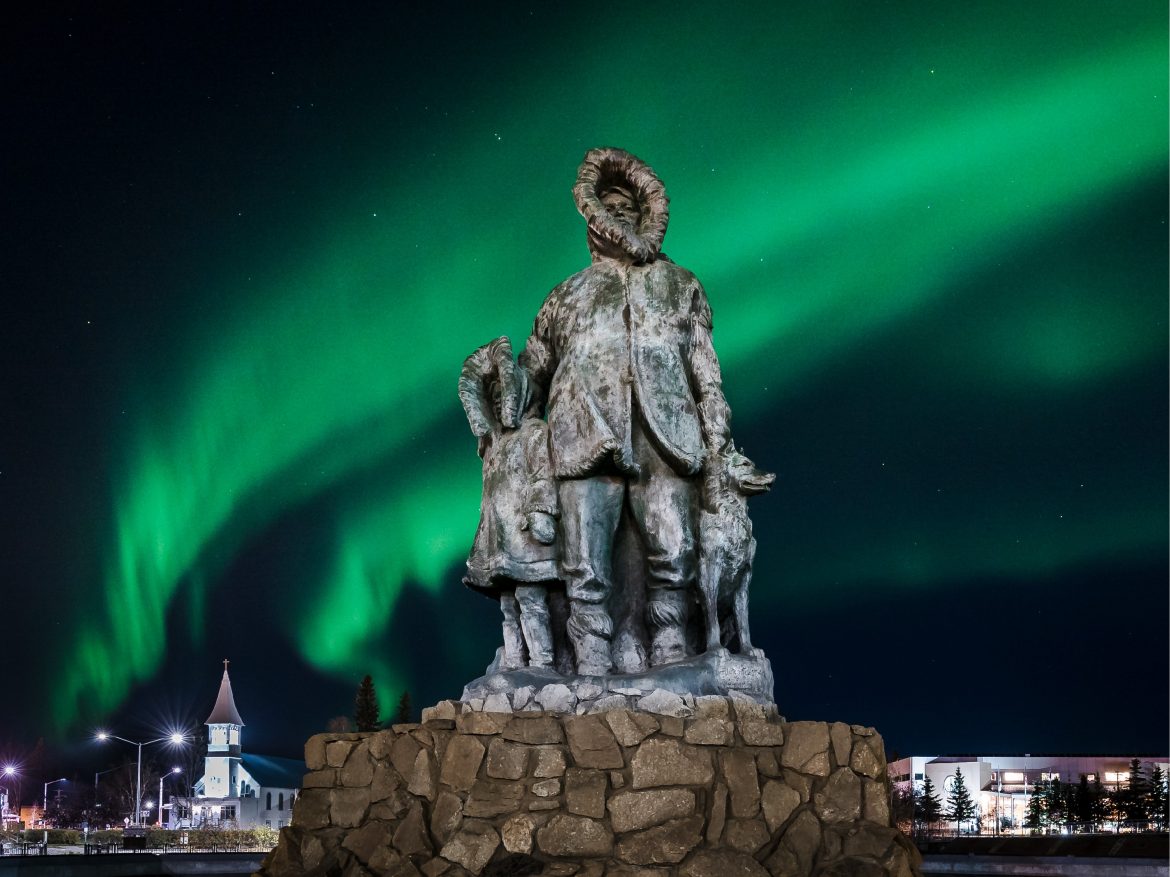
A map and guide to best viewing sites The nonprofit Explore Fairbanks has published an Aurora Viewing Map & Guide to nine of the best spots in the area for viewing the northern lights. Places range from Creamer’s Field Migratory Waterfowl Refuge just a couple of miles from downtown to farther-out locations such as Denali National Park or the community of Coldfoot, which are several hours away by car. A few locations are within a 30-minute drive, and all are well known for their excellent aurora viewing. The guide includes some basic aurora science, pro tips for photographers, and a QR code for accessing real time aurora predictions. Its centerfold map is designed to help visitors easily find the best views. Fairbanks’ aurora season stretches from August 21 to April 21. Several companies offer guided tours to see and photograph the lights. The guide is available for free at the…

An excerpt from the novel Homestead by Melinda Moustakis Note: This edited excerpt from Chapter 1, “Pioneer Peak, June 1956” is taken from the novel Homestead, with permission of Flatiron Books, a division of Macmillan Publishers. Copyright ©2023 by Melinda Moustakis. God made the trees and men make the kindling, they say. One hundred and fifty acres of white spruce and paper birch, alder, aspen, cottonwood, and willow—spears of evergreen pointed at the sky, and the pale and peeling bark, and the leaves of every branch—all for the taking if the acres are proved. Fell the trees and clear twenty acres of land to seed a crop, raise a cabin with nails and timber, and weather the seasons. This is the way to earn and own the deed. Lawrence stands where the cabin will stand, the marsh and muskeg easing miles toward the marine inlet of Knik Arm, and beyond,…

Past Disasters still haunt travelers “Could this whole world crack apart?” my three-year-old son asked me one day as we were walking along a beach on Coronation Island, a far-flung U.S. Forest Service designated wilderness area on the outer coast of southeast Alaska. We’d arrived here, to Egg Harbor, 90 miles south of Sitka, via our family’s small sailboat.  “Of course not,” I told him. “But right here, I mean. What if there was the biggest tsunami ever? Or an asteroid?” I raised my eyebrows at him. “What makes you ask?” Admittedly, our position looked precarious from a distance—on one side of us was an archipelago boasting some of the densest brown bear populations in the world; on the other was the North Pacific, whose fetch is intimidating even on a good day. If there ever was a part of the world that might swallow a person, this fit the…

A 3,000-mile journey in search of love, peace, and home by Olivia Hill The edited excerpt below is printed with permission by Olivia Hill and Woodneath Press. It’s taken from her memoir reflecting on living as a Black woman in an Alaska Native village in the 1980s juxtaposed with her own cultural upbringing. I knocked on the door, and a partially naked woman opened. “You don’t have to knock, come in, no men around.” They laughed shyly and smiled. “We run them off … You like sweat, bathe, ah? … We like it hot, first one we do this year now it’s cold … Put your clothes there then come in quick.” They disappeared through another door while I took off my clothes, slowly piece by piece, and hung them on the pegs made from birch tree limbs. This small outer room had wooden benches with space to slide your…

Following the old timers’ trail I pulled alongside my traveling partner Clarence Wood. Following his lead, I tapped my snowmachine’s kill switch. Break time. As I unscrewed the cap of my thermos and poured steaming cups of coffee for us both, melting snow hissed on our mufflers. The upper Redstone valley stretched northward into a blue-white ache. Ahead lay Iviisaq Pass, known for its terrain-driven winds; and beyond, an expanse of treeless, unpeopled country, not so much as an inhabited cabin until the village of Anaktuvuk Pass, 200 more miles to the northeast. Our laden sleds, the sort once pulled by dogs, bore gas, food, and gear to sustain us for nearly double that distance. This was our first break since we’d set out from our village of Ambler, on the upper Kobuk, outward bound on a great loop that would carry us to Anaktuvuk, south to the Koyukuk, then…

Reluctant Alaskan hero by Ray Cavanaugh Wrangel Island was never a place people would visit unless they had a really good reason. Technically part of Russia, it’s some 300 miles north of the Arctic Circle and almost as many miles away from the Alaskan coast. It tended to attract young men seeking adventure, danger, and perhaps some personal glory. For the first two, the island was a safe bet. The glory part, however, proved rather more elusive, often fatally so. This hostile piece of territory, with far more polar bears than people, had managed to become a source of international controversy, with Russians, Americans, and Canadians at different points making claims for their homeland. All this was far outside the thoughts of Ada Blackjack, until a set of life circumstances placed her directly on Wrangel’s icy surface and forever linked her name to its formidable legacy. An Alaskan Inupiat, Ada…