And into your own journey Getting off the beaten path, this issue’s theme, means different things to different people. A short hike to an overlook above a lake popular with hikers and paddlers on weekends might be all one person needs to recharge her batteries before heading back to the city. Another might think teaching students in rural Alaskan communities is sufficiently out there to qualify. Someone else might consider diving deep into frigid waters to photograph undersea creatures his blissful escape. However you frame it, getting off the main drag in Alaska is as easy or complex as you want to make it. This month, our features lead readers away from the usual to places like Naknek, Kasigluk, and Tuntutuliak in “Never a Dull Day” (page 64); a tiny cabin visited every summer in “Off-Grid in Moose Pass” (page 72); and underwater around Kodiak and Valdez in “What Lies…
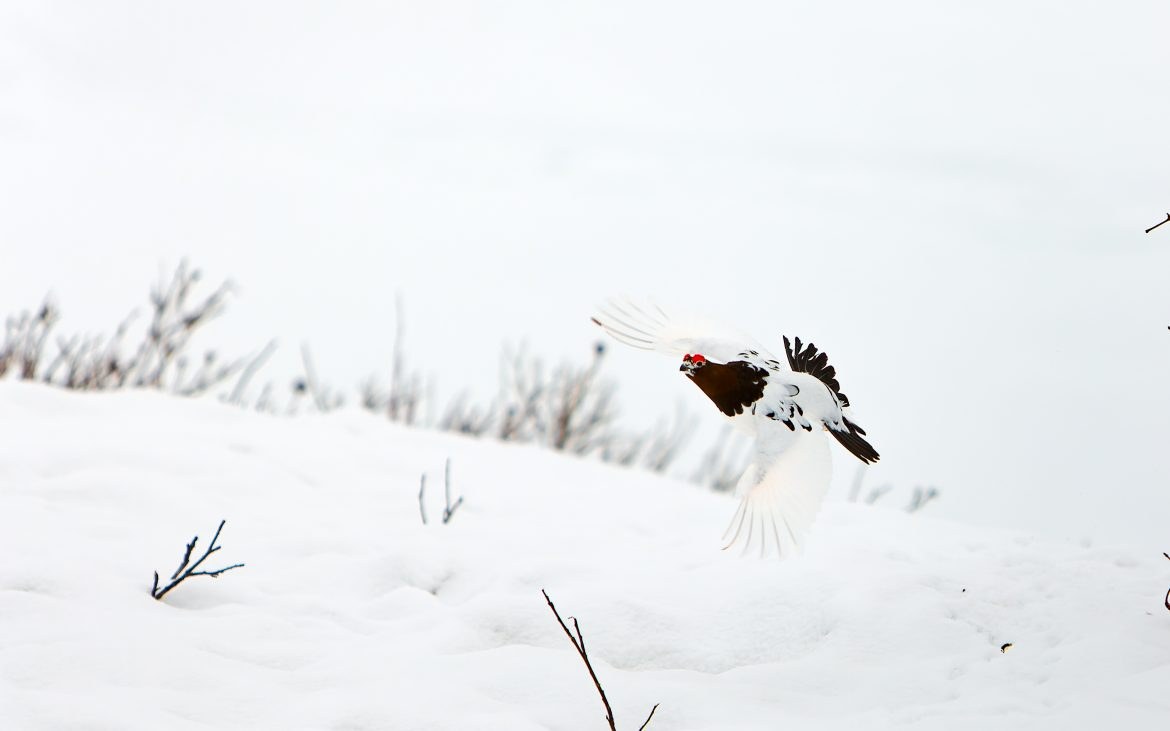
A Wildlife Sighting Primer from a Pro I’m often asked how I managed to get a particular shot of a wolf or a bear or some other wild creature in Alaska. People imagine I know of secret locations up trails that can only be accessed by ATV, snowmachine, or packraft, or that require weeks of primitive camping and sewing a coat out of leaves, fur, and pine needles to blend into the environment. That’s rarely the case. I do have a yeti costume, but that’s a different story for another day. In fact, none of my images required me to slather myself in salmon oil or bellow like a moose in heat. At this point in my life, I’m old and lazy, and I prefer to work smart, not hard, to get an image, if I can help it. What I’ve found out? Animals also prefer the path of least…
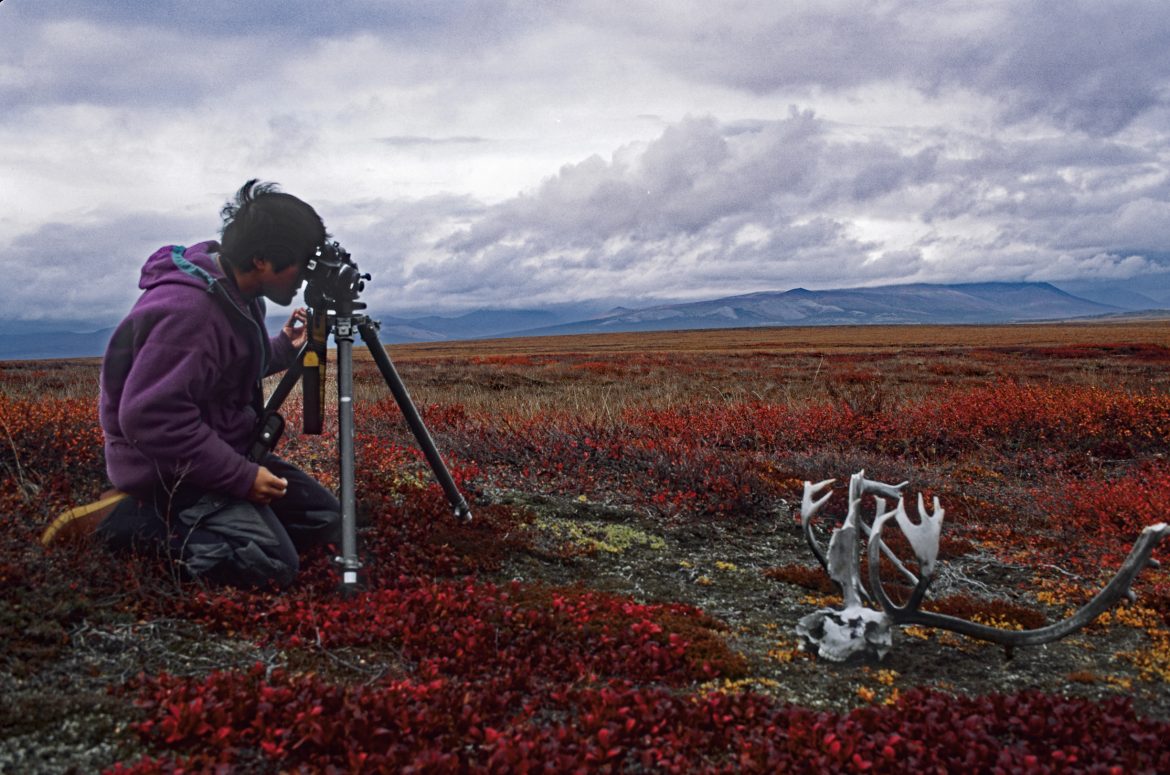
A photographic journey of the heart I knelt behind my camera tripod, gazing from the edge of a sandy knoll, northward up the Nuna valley. A few yards away, a fortyish Japanese man did the same. Before us, a weathered caribou skull lay in a blood-red swath of bearberry; beyond, an immense sweep of autumn tundra glowed beneath a furling expanse of clouds, squalls, and sun. Occasionally moving his lips without speaking, my companion seemed adrift in a trance as he studied land and sky, making adjustments and squeezing the shutter release. I divided my time between scanning the country for caribou and studying him—emulating lens choice and angle, trying and failing to mimic both his technical command and his absolute-in-the-moment absorption. At last, he turned toward me with a smile that seemed to mirror the land’s radiance. Oh look, Neek, look! It is all so beautiful. The man was…
A stroll through space in Fairbanks It is a pleasant day for a walk in the middle of Alaska, with blue sky overhead, and people perhaps looking for something to do outside, with lots of space and sweet-scented summer air around them. Not long ago, I hiked the length of a new planet-walk display on the University of Alaska Fairbanks campus with Peter Delamere. In a little less than one mile, we spanned the relative distance from the sun to dwarf planet Pluto. Delamere is a researcher and teacher at UAF’s Geophysical Institute and Physics Department. He knows a lot about each of the heavenly spheres mounted on signs along Yukon Drive, which is arrow-straight and runs up to the high point of the campus. I have known Pete for a long time. When he was a Ph.D. student here in the 1990s, I interviewed him for this column about…
Museum of the North will use Bus 142 to tell Broader Story of Alaskan Lands The Museum of the North in Fairbanks has received $500,000 to preserve the bus made famous in the book Into the Wild. The funding comes from the National Park Service and the Institute of Museum and Library Services and will help prepare the bus for public exhibit. Angela Lin, senior collections manager at the museum, acknowledges that the bus can be polarizing in Alaska and says that the exhibit will address more than Into the Wild. “We’re excited to tell a more complete story,” says Lin. Bus 142 is a 1946 International Harvester that served as a school bus, a Fairbanks transit bus, and eventually as remote housing for mine workers near the end of the Stampede Trail west of Healy. When its axle broke, the bus was abandoned on site. The bus gained global…
Two Alaska Native artists bring new color to the Anchorage streetscape This summer, Anchorage visitors can seek out two new public murals created by forerunners in Alaska Native art. The first is located on G Street on the east side of the RIM Architecture building and was painted by Crystal Worl, a Tlingit, Athabaskan, Yup’ik, and Filipino artist based in Juneau. Worl has emerged as a prominent Alaskan artist whose work is featured in public spaces in Juneau and has appeared as a Doodle on Google’s homepage. Her new mural, completed in August 2022, honors several Alaska Native groups and highlights Anchorage as a cultural gathering place. The second mural graces the The Kobuk building on the corner of 5th Avenue and E Street. Painted by Yup’ik and Inupiaq artist Drew Michael, its vivid colors recreate a mask he carved in 2019 and celebrate the rich cultural traditions of the…
Species Profile Whatever adventure you’re planning this summer, it’s not likely to match the recent journey of godwit #234684. Nicknamed B-6 and weighing less than half a pound, this juvenile shorebird gained fame last October when it flew 8,925 miles nonstop from Alaska to Tasmania in 11 days. The odyssey, which occurred largely over open ocean, was tracked via a five-gram satellite tag attached to the bird’s rump. Audubon’s online field guide describes the bar-tailed godwit as “big, noisy, and cinnamon-colored.” It is a wading shorebird that feeds along shallow waters and nests among tussocks on Alaska’s tundra. According to Dan Ruthrauff, the U.S. Geological Survey wildlife biologist who helped tag B-6, the godwit is among 37 shorebird species that regularly breed in Alaska. Ruthrauff’s crew captured B-6 last summer on the tundra outside of Nome as part of a study to better understand shorebird migrations, which are tied to…
Be a good road trip passenger Not good,” Pat said as we added our brake lights to the standstill on Interstate 40 west of Albuquerque. Semis surrounded us, idling. “Is there a way around this mess, Navigatrix?” he asked. I was already tapping my phone to check Google Maps while simultaneously flipping through the New Mexico atlas on my lap for the corresponding page. On our road trips, it’s partly my job as “Navigatrix” to find the most efficient, scenic, or interesting route. When we’d checked the app earlier, we’d seen the red section, meaning traffic delays, but figured we’d give it a try anyway, as there really wasn’t another good way to head toward our next destination. While it took us nearly two hours of driving down alternate side roads (even passing one called Alaska Loop) and then backtracking because everyone else had the same idea, I discovered one…
High Drama When the River Runs Again by Beth Grassi In late April 2014, I stood on a bridge in Fairbanks watching the Chena River waking up under my feet. Flat chunks of ice bumped and bobbed down the river, some a thin, translucent gray, others rafts of white several inches thick. Ice floes and slush hissed through the rush of river water. It felt like standing on the prow of a ship, pushing through to spring. “Spring breakup” may sound like a sitcom episode, but in Alaska it’s a landscape-size drama. Most of Alaska’s rivers freeze over in winter, with ice up to several feet thick. When the rivers finally break free, usually in April and May (or even June in the Arctic), ice floats downstream. Sometimes ice jams—jumbles of ice floes—dam up a river. Large ice jams can cause dangerous flooding. Breakup plays out differently each year on…
For most of my life I’ve believed there’s no better overall camp stove than the MSR XGK. However, I recently began using the MSR Dragonfly Stove and I’m not so sure anymore. I was surprised to learn the Dragonfly is capable of burning multiple types of fuel. While I have only burned white gas in mine, this option really increases the stove’s versatility for trips to places where white gas is not available. It’ll take about 130 minutes for the Dragonfly to get through a 20-ounce bottle of white gas in temperatures above freezing. Fuels like unleaded gas and diesel really gunk up a stove, but the Dragonfly is easy to clean. It burns almost as hot as the XGK, but it offers more cooking opportunities with its extra wide support and, most importantly, with a flame you can lower to a simmer for cooking foods like pancakes or a…