SSP is a network of large and small businesses, tribal governments, conservation groups, and NGOs working and learning together to help sustainable economic development balanced with environmental and social well-being thrive.

SSP is a network of large and small businesses, tribal governments, conservation groups, and NGOs working and learning together to help sustainable economic development balanced with environmental and social well-being thrive.

The family behind Synergy Gardens in Homer is dedicated to growing garlic and sharing their garlic love with all of Alaska.
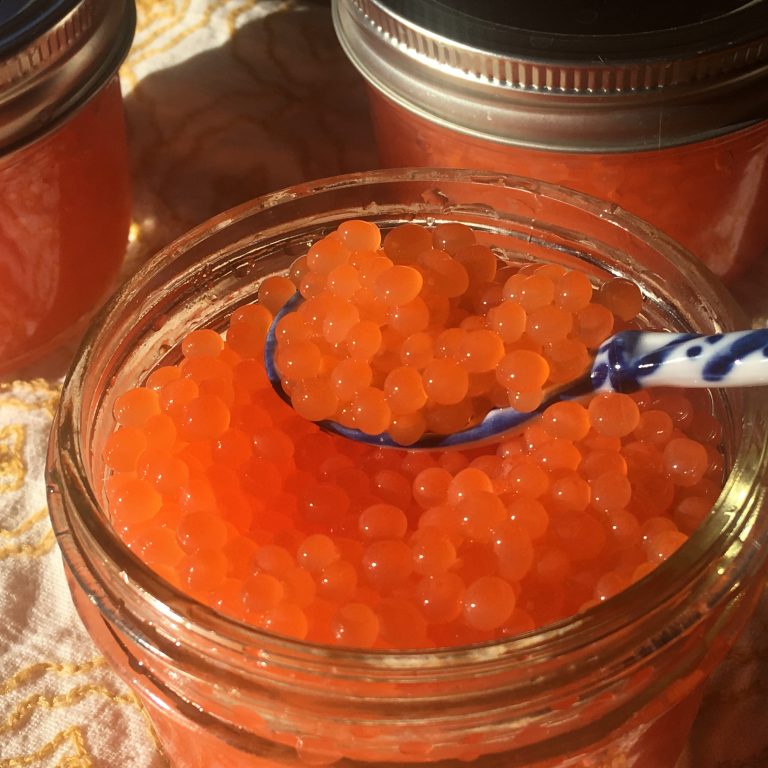
To make salmon caviar first place the egg skeins in a large glass or ceramic bowl and cover with very hot tap water. After a minute or so, begin to work the skeins by gently massaging the eggs free of the sac. Place the sticky membrane and eggs that are too clingy in a separate bowl to use in your compost. Change the water often, keeping it as hot as your hands can tolerate. After you remove the bulk of the skeins, continue rinsing with hot water, now using your fingers to delicately churn the eggs. As the water becomes tepid, drain the fluid and notice white skein membranes floating to the surface like little ghosts. Continue this until there are no more skein spirits rising to the surface. The eggs will have turned an opaque pink by now, but that will soon change. Cover the eggs with clear, cold…

An adult female bear peers through a dense thicket of cow parsnip. During the summer months, Kodiak turns a lush, vibrant green as thick vegetation carpets the island. Kodiak bears balance their diet with a variety of plants, including grass. Photo by Lisa Hupp. With 1.9-million acres to wander and no portion more than 15 miles from the Pacific, Kodiak National Wildlife Refuge includes some of the most diverse habitat on the planet, covering the southern two-thirds of Kodiak Island, all of Ban and Uganik islands, and a section of Afognak Island. Though notorious for its famed denizen, the Kodiak brown bear, a genetically distinct subspecies of browns/grizzlies, the refuge protects more than just big bruins. Consider that among the lush fjords, valleys, wetlands, and 4,000-foot peaks, more than 1,000 pairs of nesting bald eagles claim the area as their home, along with 250 species of migrating or breeding fish,…

Bull muskox spar by butting heads, sometimes running at each other full bore before colliding. Four inches of horn and three inches of bone protect the brain from injury during this violent contact. The first time I encountered muskox in the wild I felt as spectacular as Tom Cruise dancing around in his underwear and football helmet in the movie Risky Business. I was skiing across the Arctic National Wildlife Refuge (ANWR) in March as mountains and the coastal plain glowed blue in the winter light. ANWR, long known as the battleground between wilderness and oil lovers, is the sort of place you can slow dance with your inner Frankenstein without the judgement of others. Better yet, it’s one of a handful of regions in Alaska you can see muskox. A herd of 15 grazed on a windswept rise above a frozen river ahead of me. A bull hoofed at…

Teresa Whipple loves bears more than beer, rodeos, and even eight-week old yellow lab puppies. She began her bear viewing and guiding career a decade ago in British Columbia’s Great Bear Rainforest. There, she met a coastal grizzly nicknamed Bella, whose beauty, elegance, and intelligence inspired Teresa to venture deep into the bear world. Now, Teresa leads bear viewing trips all over Alaska, including grizzly havens like Admiralty Island and Katmai National Park. Right around the time brown bears are denning up for the winter, she often travels to Hudson Bay to guide polar bear adventures. After years of hanging with bears, Teresa created Ursus Major Training & Consulting, a company that specializes in bear safety training and education. Bear behavior and safety are complex, nuanced topics, and there’s a lot of contradictory information out there. Teresa’s training programs are customized to companies’ and individuals’ unique needs and offer a…

Biologist David Scheel with the day octopus he raised in his living room. Photo courtesy Passion Planet Ltd/Ernie Kovacs. David Scheel is a professor of marine biology at Alaska Pacific University, and he’s been studying octopuses for more than 25 years. Recently, he put an aquarium in his living room and raised a pet octopus that the family named Heidi. In 2019, PBS released the documentary Octopus: Making Contact, which chronicled the interactions in the Scheel household as the family observed and bonded with Heidi. As told to and edited by Alexander Deedy How did you first get interested in octopuses and why are they a fascinating creature for you? Well, I’ve always liked octopuses. What’s not to like, right? They’re kind of inherently interesting creatures. I have also spent time studying African lions, bats, rodents, killer whales, seals, seabirds, and crabs, among other animals. They’ve all been interesting. Over…

Salads at locally owned Turkey Red in Palmer are just one healthy, delicious menu item. Other dishes include grilled polenta, chicken with figs, moussaka, cioppino, soups, hot and cold sandwiches, pizza, and an array of desserts. Photo by Kaylene Johnson-Sullivan. Alex Papasavas did not set out to become a chef much less the owner of one of the most popular restaurants in Palmer, Alaska. In the early 1990s, she worked for the National Outdoor Leadership School (NOLS) as a horse packer at the Three Peaks Ranch in the Wind River Range of Wyoming. When the ranch cook had to leave for a family emergency, Alex agreed to fill in. “I thought, my gosh, I don’t know anything about cooking,” Alex said. Her saving grace was a 1984 book, Food and Cooking: The Science and Lore of the Kitchen by Harold McGee. “It just opened the door for me.” Since then,…

A bull moose gazes at the photographer in this shot taken during the autumn rut in Alaska’s Kincaid Park. Photo by Ken Marsh. If your mind isn’t clouded by unnecessary things, this is the best season of your life. ~ Wumen Huikai Alaskans hunt and gather because it is our tradition and because the land is willing; even when times seem hard, say, in darkest, cold December, Alaska has a way of providing for her own. Yet of the seasons, none better define this culture of living off the country than the golden days of late August through October. Not even summer provides for its denizens more broadly or more certainly than do the days of fall. Particularly if you look beyond the belly and into the soul. A couple of Septembers ago, I went about my lifelong moose hunting ways, but with a camera instead of the old Remington…

A lone bear stakes out his fishing territory beneath Brooks Falls in Katmai. Photo by Michelle Theall. Alaska’s eight designated national parks cover over 41 million acres. For scale, that’s twice the size of all of the Lower 48 national parks—from Death Valley to Big Bend—added together. National parks are considered the crown jewels of each state—important enough to be protected for all—and Alaska is no exception. It just, well, has a bigger crown. Alaska is romanticized and revered for its wildness, its vast and forbidding landscapes, and its almost mythic number of creatures. The diverse flora and fauna here exist among famous mountains, but also unnamed and unclimbed peaks and salmon-rich rivers and remote streams. There’s a reason these areas are protected: their wild beauty and wonder represent the best Alaska and, thus, our country, has to offer. Visiting all of the parks requires some logistical gymnastics—ideally broken down…