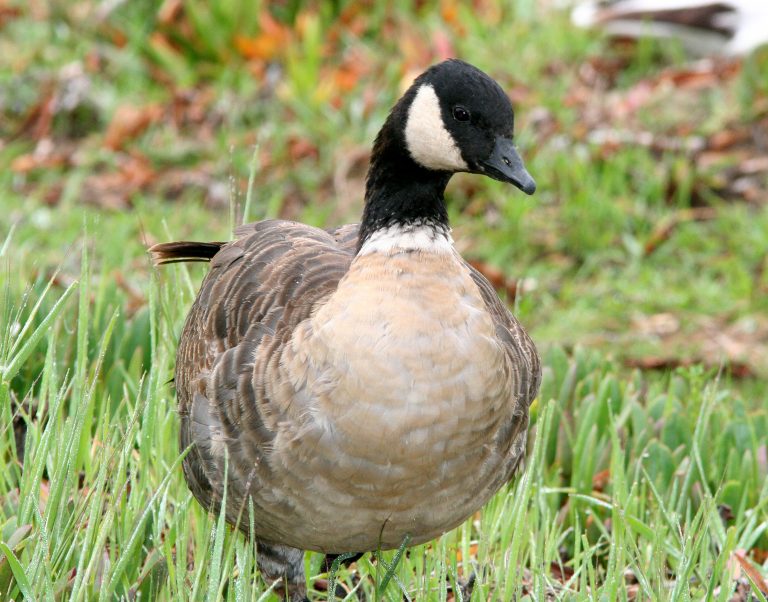
After seeing the Aleutians while serving there as an Army officer during World War II, Robert Jones knew he wanted to return and protect the area’s rich wildlife. In 1949, Jones became the first manager of what is now the Alaska Maritime National Wildlife Refuge. A famously tenacious champion of wildlife rehabilitation efforts, he became known as “Sea Otter” Jones for his efforts to save sea otters and other species in the Aleutians. Jones spearheaded the effort to remove invasive foxes that were decimating wildlife in the Aleutians and is often credited for the recovery of the Aleutian cackling goose, a bird once thought extinct that was removed from the endangered species list in 2001.
Art by Tim Bower Why do moose have that weird goatee thing? The unofficial answer is… well… because… nature’s weird? The flap of skin that hangs underneath a moose’s chin is known as a dewlap, or bell. Scientists have theories about the purpose of the dewlap, including that it may be used for communication during the rut. Another theory is that it may act as a sign of social hierarchy; a larger dewlap could signal a more dominant male. Ultimately, there’s no conclusive evidence explaining exactly why moose have dewlaps. That means the official answer is, well, because nature’s weird. Nature is, in my opinion, pretty neat. What’s the neatest thing about nature in Alaska? During winter, wood frogs in Alaska will stop breathing, their hearts will stop beating for days to weeks, and two-thirds of their body will freeze before they thaw and return to life as usual in…

A Harlequin duck. Photo courtesy Andy Reago & Chrissy McClarren, Wikimedia Commons Red-faced cormorant Nesting on cliffs or steep slopes above cold ocean water, this bird can be spotted along the Aleutian Islands and around the Kenai Peninsula. Alaska is the only place this cormorant lives in the United States. Willow ptarmigan The Alaska state bird masterfully camouflages itself by turning white in winter and mixed browns and reds in summer. Identify this largest of the state’s ptarmigan by its wide bill or feathered feet. Harlequin duck Named because the blue-gray feathers with striking black, white, and rufous markings look like medieval court jesters, or harlequins.

A bull moose rubs his antlers on weather instruments in Anchorage. Photo courtesy Dan Peterson, NOAA/NWS/WSFO Anchorage It’s uncommon to see wolverines in Anchorage, but one rogue wolverine ventured into the city where it could prey on chickens and chase stray cats. Biologist Dave Battle got a call one day that the wolverine had killed someone’s rabbits and stashed them under a low deck. Every time the homeowner approached the deck, the wolverine growled. To solve the dilemma, Battle first used a garden tool to pull the rabbits out from under the deck. Then, he and a fellow biologist turned on the hose and jetted water at the animal. The wolverine sprinted out from under the deck and never returned. “Not every day that you spray a wolverine out from under a deck with a garden hose,” Battle says. Battle, who has worked as the management biologist for the Anchorage…

MULTI-USE TRAILS CONNECT ALASKANS On the North side of the Alaska Range, I skidded and bounced down the Dalzell Gorge struggling to keep my expedition-loaded fat-tire bike upright. Mounds of frozen dirt and icy roots flung me sideways and I squeezed both brake levers, trying to stay on two wheels and not wrap myself around a tree. Suddenly, the decline steepened; I spotted a glimpse of bare ice ahead, and let off the brakes to avoid skidding out. After a while, the trail leveled out into a meadow blanketed in crusty snow. The frosty branches on the black spruce trees glistened in the morning light. I lowered my bike and yanked out my camera. A dog team was behind me, coming fast, and I wanted a photo. Through the forest above me, could hear the dog driver gently encouraging his team to slow down. “Wooo. Easy…easy. Good girl.” I flipped…